


Why more PE-backed companies are keeping two paths to exit on the table—and what it takes to make the strategy work
The IPO window has been reopening. M&A deal flow is back. And a meaningful cohort of private equity-backed companies—many of them past their expected hold periods—are now staring down a question their sponsors have been waiting years to answer: which path to exit do we take?
For some, the answer is simpler than it sounds. Because increasingly, the most sophisticated exits aren’t choosing a single path at all. They’re running both simultaneously.
The dual-track exit—simultaneously preparing for an IPO and managing a sale process—isn’t a new concept. But it’s having a meaningful resurgence right now, driven by a specific convergence of market conditions, PE portfolio dynamics, and the hard-earned lesson from the 2022–2023 window closure that certainty is never guaranteed. Understanding why it’s back, what it actually demands, and where companies tend to fall short is increasingly relevant for the CFOs, controllers, and finance leaders who’d be responsible for executing one.
What is a dual-track exit?
A dual-track process means running an IPO preparation and a sale (M&A) process for the same company at the same time. Both tracks are real, both are resourced, and neither is the committed outcome. The company—and its advisors—maintain optionality until a defined decision point, typically receipt of final M&A bids or completion of SEC review, at which point the board commits to one path and closes out the other.
Why this strategy is back in the conversation
To understand the current moment, it helps to start with what happened right before it. Between 2022 and early 2024, both major exit paths slowed dramatically. The IPO market contracted sharply as rates moved hard and growth valuations compressed from the frothy highs of 2020–2021—new issuances didn't disappear entirely, but the window narrowed to a fraction of what it had been, and the risk of a poorly-timed offering became very real. M&A slowed in parallel—bid-ask spreads widened, deal financing got expensive, and buyer conviction softened. Companies that had been building toward exits pumped the brakes, reassessing timelines and, in many cases, finding neither path offered the certainty it once had.
What’s different heading into 2026 is that both paths are genuinely open again. Equity markets have been constructive. The rate environment has stabilized enough that investors can underwrite growth without the kind of uncertainty that paralyzed decision-making during the tightening cycle. Institutional appetite for new issuances has returned. M&A volume—on both the strategic and sponsor-driven sides—has recovered meaningfully.
The dual-track exists precisely because neither path is certain. When one or both were closed, the strategy was mostly theoretical. Now that both are open, the conversation is real again—and the underlying logic is more compelling than ever.
The PE portfolio pressure driving the urgency
For PE-backed companies specifically, the market recovery is landing at a moment of real portfolio pressure. The typical hold period in private equity is four to six years. A significant number of portfolio companies that should have exited in 2022 or 2023 didn’t—the market simply wasn’t there. That backlog has been accumulating, and LP patience, while durable, is finite.
LPs haven’t seen the distributions they were expecting. That pressure flows directly to portfolio company management teams—not as noise in the background, but as a concrete driver of the timeline. Sponsors are motivated to transact. The question is how to maximize value given that motivation, not just how quickly to exit.
That’s where the dual-track framework becomes particularly relevant. PE firms are well-positioned to run it—they have the advisor relationships, the process discipline, and the institutional experience to manage two tracks simultaneously. And critically, they have a clear-eyed view of what they’re optimizing for: a superior return, not just a completed transaction. The dual-track provides the architecture for making that maximization real.
The logic: Two tracks that make each other stronger
The dual-track strategy works because the two processes don’t just coexist—they actively reinforce each other. It’s a structural feature of the framework, not an accidental benefit.
On the M&A side, a credible IPO preparation signals to buyers that the company is serious, organized, and has already attracted market scrutiny. Clean audited financials, a documented equity story, a well-framed set of KPIs—these aren’t just IPO deliverables. They’re M&A negotiating assets. A buyer can’t discount a company that has passed the kind of diligence an S-1 requires.
On the IPO side, active buyer interest—and the possibility that the company might actually be acquired—creates urgency that underwriters and institutional investors find reassuring. There’s a market-validated floor on the business. The roadshow isn’t happening in a vacuum.
The combination creates competitive tension that neither track produces on its own. Potential acquirers who know a credible IPO is in development can’t anchor bids low. And if the IPO window softens, or roadshow reception is weaker than expected, there’s a live sale process to fall back on. Neither outcome holds the company hostage.
Worth noting: Historically, most dual-track processes end as M&A transactions. The IPO frequently functions more as a competitive forcing mechanism than as the actual destination. Once the S-1 is filed and SEC review begins, buyers know a public offering is real and on a defined timeline—it puts a clock on the process in a way that a purely private sale never does. That's not a failure of the strategy. In many cases, it's the intended outcome.
What each track actually requires
The dual-track’s appeal can obscure how demanding it is to execute. Both tracks are real processes with real deliverables—and they run simultaneously, drawing from the same management bandwidth and the same finance organization.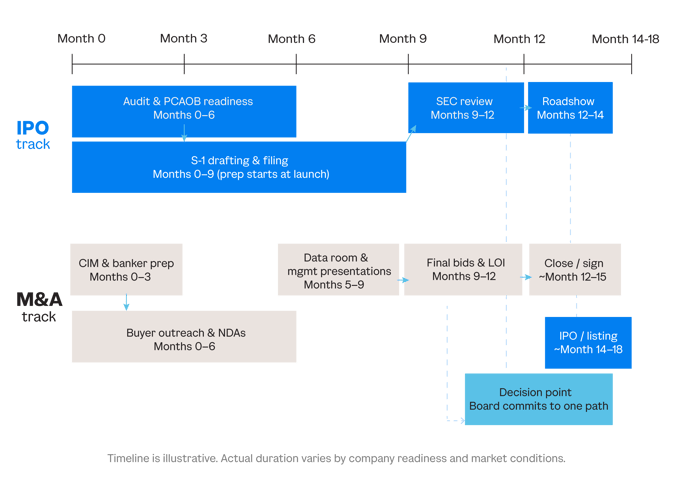
Both tracks run simultaneously—the decision to commit to one path typically comes around month 12.
The IPO track
At its core, an IPO is a registration process. For many companies, the S-1 registration statement will require up to three years of audited financial statements under U.S. GAAP, audited by a PCAOB-registered firm, though the specific requirements vary depending on filer status and company history. For companies that have been audited privately but not by a PCAOB-registered firm, the auditor transition alone can add meaningful time before the S-1 process even starts. Layer in the SEC comment cycle, which typically runs three to six months, and a company starting from scratch on public-company-grade infrastructure should plan for a serious preparation runway of a year or more.
The internal controls dimension is often where PE-backed companies are furthest behind. SOX compliance requirements vary by filer type, and emerging growth companies in particular benefit from a phased ramp-up period before full attestation requirements apply. But that relief isn't a reason to defer the work. Control environment weaknesses that have accumulated over years of operating privately take real time to remediate, and material weaknesses identified during or after an IPO can damage investor confidence and complicate the underwriting relationship. This is a valuation issue, not just a compliance one.
Carve-out situations add additional complexity. Constructing historical financial statements for a business that has operated as part of a larger enterprise requires allocating costs, unwinding intercompany transactions, and documenting shared services arrangements. It's one of the most technically demanding financial reporting exercises in any exit context, and it almost always takes longer than the team originally estimates.
And then there's the post-IPO reality, which sometimes gets underweighted in the planning conversation. Once public, the company is on a recurring reporting cadence: 10-K, 10-Q, and 8-K filings, earnings calls, and ongoing investor relations obligations. The IPO is the beginning of a new operating mode, not the finish line.
The M&A track
A sale process is more controlled and more confidential than an IPO, and it typically moves faster to a definitive outcome. The banker prepares a Confidential Information Memorandum, manages the buyer universe from broad outreach to a shortlist, facilitates data room access and management presentations, and negotiates toward a signed LOI. From formal launch to a signed LOI typically runs four to six months; from LOI to close, add two to four months more.
Financial sponsor diligence has gotten meaningfully more rigorous in the post-cheap-money environment. When buyers can no longer rely on multiple expansion or cheap refinancing to generate returns, the quality of what they’re acquiring matters much more. Quality of earnings reports are standard on virtually every PE-backed transaction now—and they go deep on revenue quality, customer concentration, add-back validity, and working capital normalization. Controls diligence is increasingly part of the playbook as well; buyers are pricing control environment risk into bids, or holding it as post-LOI renegotiation leverage.
The working capital negotiation at close deserves particular attention, because it consistently catches companies off guard. The working capital peg is the agreed normal level of working capital the seller delivers at close, and it's where sellers and buyers routinely fight. Small definitional differences compound into meaningful cash swings in the post-close adjustment. Companies that haven't done rigorous pre-LOI working capital analysis are at a real disadvantage in that negotiation.
The key tradeoffs: certainty, confidentiality, and timeline
Running both tracks together requires clearly understanding what each path offers and what it demands—because these aren’t symmetric.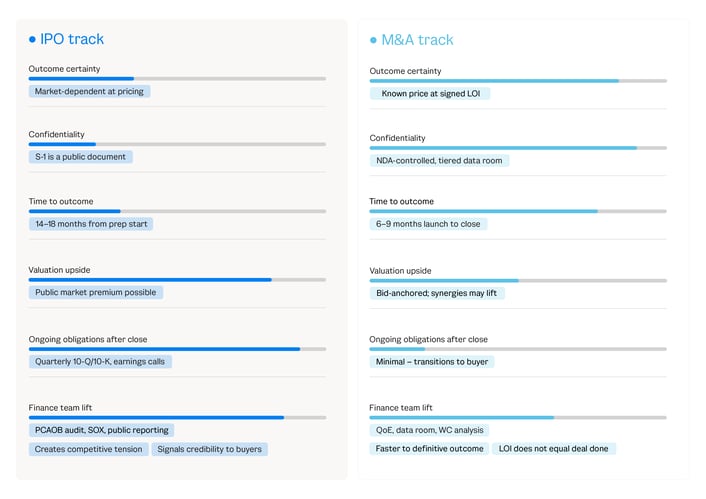
Bar lengths are relative indicators, not absolute scores. In a dual-track, both paths run simultaneously until a board decision point.
Certainty: A signed M&A definitive agreement delivers a known price and a defined path to close. An IPO is subject to market conditions at the moment of pricing. You can be fully registered, fully prepared, and on a roadshow, and still pull the offering if the market moves against you. M&A offers more certainty at a known price; the IPO offers the possibility of capturing public market upside, but only if the window is open at the end of a long preparation runway.
Confidentiality: M&A is tightly controlled. NDAs, tiered data room access, a defined universe of counterparties. An IPO requires public disclosure at a defined point. The S-1 is a public document, and once filed, your financials, risk factors, and business narrative are visible to competitors, customers, employees, and the M&A counterparties you're simultaneously negotiating with. Managing the sequencing of that disclosure is a real planning exercise.
Timeline and resource intensity: M&A typically closes faster, roughly six to nine months from launch. IPO requires a longer preparation horizon and depends on market timing at the end. Running both with the same management team and the same finance organization creates genuine resource pressure. Underestimating that demand is one of the more common ways dual-track processes run into execution problems.
The IPO market that’s open today isn’t the one from 2021
One thing worth being explicit about: the current IPO market is more disciplined than the 2020–2021 environment that set expectations for many management teams and sponsors. That earlier market was unusually forgiving. Near-zero rates meant growth companies were valued on revenue multiples that assumed capital was essentially free. That era is over.
What's open today is different. Investors want to see profitability, or at least a credible path to it. The equity story needs to be grounded in an economic model that holds up under real scrutiny, not just a compelling narrative about total addressable market. Revenue quality, customer cohort behavior, working capital efficiency, the defensibility of adjusted EBITDA — these metrics have to be presented with rigor and supported by a financial infrastructure capable of sustaining ongoing public company reporting.
That higher bar isn't bad news. It's a more honest market, and companies that have done the preparation work to meet it are in a genuinely strong position. The challenge is that the preparation is more demanding than a lot of companies currently operating in a PE portfolio context have yet undertaken.
Collapsing from two tracks to one
One of the most strategically important—and frequently under-planned—moments in a dual-track process is the decision to commit to a single path. By the time a company reaches that point, the management team has been running hard for months. M&A bids are on the table. The IPO market may have shifted. Exhaustion is real.
The quality of that decision depends almost entirely on how clearly the framework was defined at the outset—what criteria matter, what information is needed, who’s in the room. The best dual-track processes plan that decision point explicitly, upfront, and have the discipline to follow through on the plan. Companies that arrive at it without a framework tend to make the call on exhaustion and pressure rather than strategy.
That planning is fundamentally a finance and operations question. The CFO often has the clearest view of where each process actually stands—what the financial story looks like relative to what was presented to buyers, what the control environment can sustain, what working capital says about the real health of the business. That’s why the CFO’s role in a dual-track process is central, not peripheral.
What this means if you’re planning ahead
The dual-track exit strategy is a rational and increasingly relevant framework for this market moment—when both paths are genuinely open, PE exit pressure is real, and the lessons of 2022 have reinforced that no single path to liquidity is guaranteed.
But the gap between where most companies currently operate and where they need to be to run a credible dual-track process is almost always larger than expected. The financial infrastructure requirements, the internal controls readiness, the documentation and narrative discipline—these aren’t things you can build in the six months after a process has launched. They need to be built well before, ideally over the 12 to 24 months preceding any formal exit activity.
The good news is that doing the work now—regardless of which exit path ultimately gets chosen—produces a materially better outcome on both. The financial rigor that makes you a credible IPO candidate is the same rigor that protects your valuation in an M&A process. There’s no version of serious exit readiness that doesn’t pay off.
Thinking about an exit in the next 12–24 months?
Embark works with PE-backed and growth-stage companies at every stage of the exit readiness journey—from financial infrastructure builds and SOX readiness to transaction support and post-close integration. Reach out to start the conversation.