Find—and fill—the gaps nobody's checking for yet
The board assumes the numbers behind the strategy conversation are solid. A buyer's diligence team assumes the story your financials tell holds up under scrutiny. Budget planning assumes your systems can actually produce the reporting you're building around.
Those assumptions hold up fine, right up until someone actually checks. This July, we're looking at a few of the places gaps tend to hide: in the risks compounding underneath the business that nobody's mapped in one place, in ERP systems that have quietly stopped keeping up, and in the deal preparation that increasingly separates who wins and who doesn't.
None of it feels urgent yet. That's exactly why it's worth a look now, while checking is still your idea and not someone else's.
.webp?width=189&height=41&name=Adam%20Olsen%20Signature%20(1).webp)
Adam Olsen
National Head of Practices, Embark
| IN THIS EDITION Listen in: Three risks, one blind spot. The final podcast episode in our GRC series on how AI, cyber, third-party, and regulatory risk compound together See how: 30+ roles, one acquisition, zero missed closes. Embark rebuilt an entire finance team without a hiccup Select the right ERP: Is your ERP quietly falling behind? A checklist for finding out before budget season does Watch for the clause: The one contract detail that can turn a sale and leaseback into a hidden financing liability |
FEATURED RESOURCE
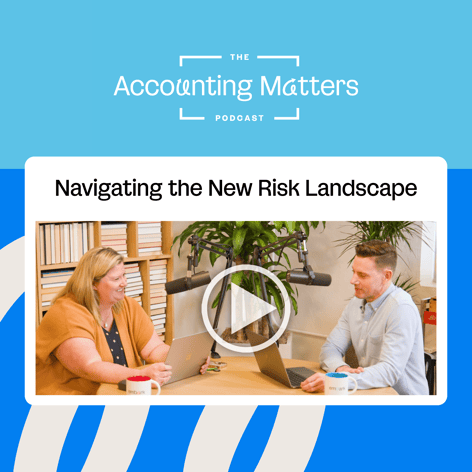
New podcast episode: The blind spot in most risk functions
Most risk functions are still built to handle AI, cybersecurity, third-party exposure, and regulatory change as separate problems. National Head of Practices Adam Olsen and FAS Principal Allison Bradshaw break down why that's the real gap, not a missing control, but a missing view of how these risks feed each other, and what it actually takes to see the full picture instead of managing each piece in isolation.

CASE STUDY
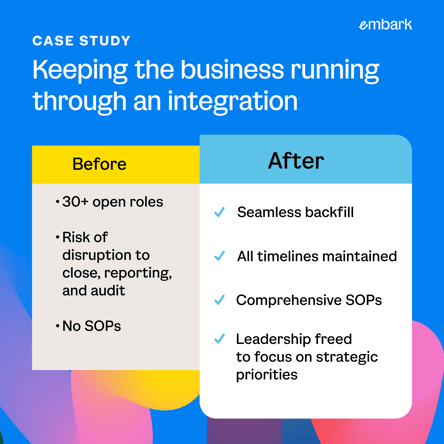
30+ roles filled, zero missed closes
When a global manufacturer moved to consolidate its newly acquired finance function into a single headquarters, Embark stepped in with more than 20 consultants to fill 30-plus roles across cost accounting, financial accounting, FP&A, and controllership. The team kept every close cycle and audit on track, built the documentation and processes the client didn't have before, and onboarded each incoming permanent hire with a clean handoff. Years later, Embark consultants are still embedded and driving value for the company.

ERP SELECTION CHECKLIST
A confident ERP selection starts here
Mid-year is a good time to start an ERP evaluation, whether it's your first system or you're replacing one that's stopped keeping up. This checklist covers what to nail down before you talk to a single vendor: understanding your actual needs, evaluating vendors on more than a feature list, calculating true total cost of ownership, and running a selection process built to hold up.

GUIDE
Sale and leaseback deals fail for one of two reasons
Sale and leaseback deals free up capital while keeping the asset in use, but the accounting doesn't always follow the intent. A single clause can turn a clean capital-raising event into a financing liability on the balance sheet:
-
A repurchase option or obligation the seller retains
-
A leaseback that ends up classified as a finance lease
Either one means the asset stays on the books and the proceeds get treated as debt. Get the pre-closing checklist to catch these issues before the term sheet is finalized.
.png?width=426&height=426&name=20260707-Embark-SaleLeasback-1200x1200_1%20(2).png)

ON OUR RADAR
AI investments on the balance sheet, SEC rulemaking ahead, and Europe's sustainability rules take shape
-
Your AI investments need a place on the balance sheet: FASB issued ASU 2025-06 in September 2025, the most significant update to internal-use software accounting guidance in years, aimed at how companies account for AI development costs. Internal-use software falls under one framework; software built to sell or license externally falls under another with a much higher bar for capitalization. The standard takes effect for calendar year-end companies in 2028, but the groundwork to get there takes time.

-
SEC Signals Next Wave of Rulemaking: On July 7th, SEC Chair Paul Atkins spoke on the SEC's 2026 Regulatory Agenda to confirm the Commission's spring proposals were just the opening act. Beyond semiannual reporting and filer status simplification, the agenda flags executive compensation disclosure reform, foreign private issuer eligibility, crypto assets, shareholder proposal modernization, and exempt offering pathways as areas to take up this year. None of these have proposed rule text yet, so treat the agenda as a preview, not a commitment. So far in 2026, the Commission has moved quickly on its rulemaking agenda making this one to watch closely in the months ahead.
-
Europe Locks In Its Sustainability Rules — US Multinationals, Take Note: The European Commission adopted the revised ESRS on July 3rd, closing out the two-year Omnibus simplification process. The final standards apply to companies above 1,000 employees and €450 million in net turnover, cut mandatory datapoints, and swap the original bottom-up materiality assessment for a more proportionate top-down approach. Pending EU Parliament and Council review, the standards take effect this November, and become mandatory for fiscal year 2027. The simplification is real, but so is the compliance lift for US companies with EU subsidiaries or investments. Those already reporting under the first ESRS set can adopt the revised version early.

EMBARK NEWS.png?width=735&height=418&name=july%20newsletter_embark%20news%20(1).png)