
The Supreme Court's February 20, 2026, ruling that tariffs imposed under the International Emergency Economic Powers Act (IEEPA) are unlawful has set off a chain of events that finance and accounting teams across the country are still working to fully understand.
The Court of International Trade (CIT) subsequently ordered Customs and Border Protection (CBP) to begin processing refunds for IEEPA duties paid. CBP responded by outlining a phased plan to build a new automated system—the Consolidated Administration and Processing of Entries (CAPE) module within its existing ACE platform—to handle the volume, which spans more than 330,000 importers and 53 million entries. Individual CAPE components were reported as 40–70% complete as of mid-March, with a full refund processing timeline that could extend several months beyond initial system launch.
For finance leaders, the ruling represents both a potential recovery opportunity and a fresh layer of accounting complexity. Overlaid on that is a tariff environment that has not gone quiet: Section 122, Section 232, and Section 301 tariffs remain in place. A 10% global tariff under Section 122 was invoked in the immediate aftermath of the ruling. The landscape is still dynamic, enforcement is ongoing, and the Administration is expected to challenge the breadth of the CIT refund order. What the ruling provides is not certainty—it provides a set of new questions that companies need to answer through their financial statements, disclosures, and planning processes.
This post walks through what those questions look like from where finance and accounting sit: how to think about recognizing tariff refunds, what the pervasive financial reporting implications are, and how FP&A and supply chain finance need to adapt to a world where tariffs have become a structural cost variable.
|
Table of Contents Where Finance Leaders Should Focus |
The Refund Question: What Companies May Be Entitled To—and How to Account for It
The starting point for most finance teams is whether they have a recognizable asset for tariffs already paid under IEEPA. The answer is more nuanced than many would prefer.
The loss recovery model governs recognition. Under U.S. GAAP, two acceptable approaches exist for recognizing an IEEPA tariff refund receivable, and the right answer depends heavily on how a company assesses the current state of uncertainty. The refund mechanism is still being built, legal challenges to the CIT's refund order are expected, and CBP has not yet formally acknowledged individual refund amounts.
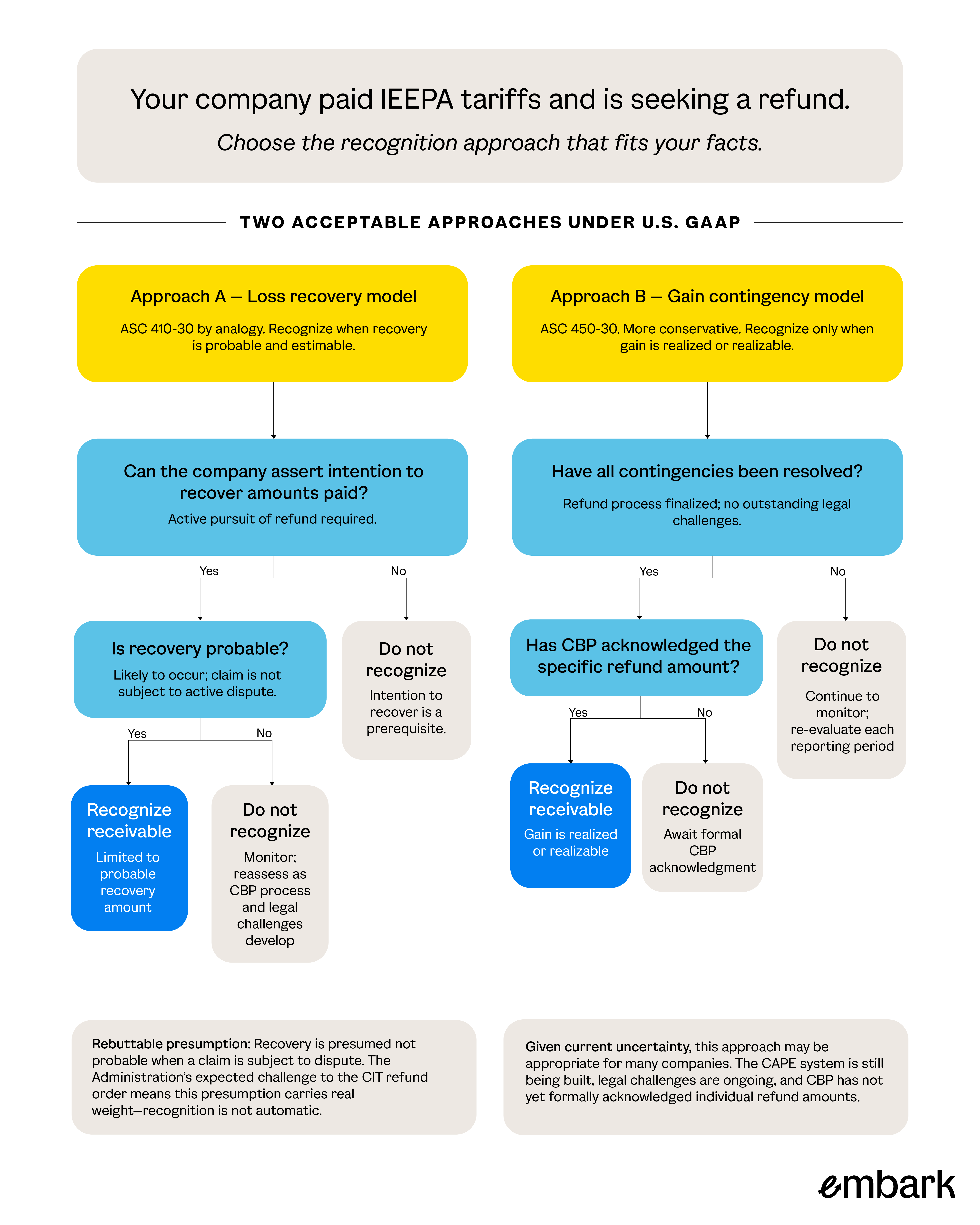
Classification follows original treatment. For companies that do recognize a recovery, the guidance is clear that the credit should follow the original debit. If IEEPA tariffs were capitalized into inventory cost, the recovery reduces either the carrying value of remaining inventory or cost of goods sold for inventory already sold. If tariffs were capitalized into PP&E, the recovery reduces the asset's cost basis. Companies should evaluate their inventory turn and costing methodology to determine the appropriate allocation between inventory and COGS.
Obligation derecognition is a separate question. Companies that have recorded payables for IEEPA duties on goods imported before CBP stopped collecting, but not yet remitted, should derecognize those payables in the reporting period when they are legally released from the obligation to CBP. This is a different analysis from the refund receivable question, and the timing of each should be evaluated independently.
Customer-facing obligations add another layer. Companies that passed IEEPA tariff costs through to customers, either explicitly or through pricing, must evaluate whether they now have an obligation to provide refunds to those customers. The analysis turns on contract terms, customary business practices, and whether the company actually obtained a government refund. A refund to a customer is generally treated as a reduction in the transaction price, not as an expense. If refunds are not contractually required but are expected to be voluntarily provided, companies must evaluate whether contract modification or price concession accounting is appropriate. This is not a small matter for companies with complex customer contract portfolios.
Non-importer exposure. Companies that did not import goods directly but paid higher prices from vendors whose costs increased due to IEEPA tariffs face a different question: do they have a contractual right to share in any refund their vendor receives? If no such right exists in the contract, recognition cannot occur until that right is obtained through a modification. This is a frequently overlooked scenario in multitiered supply chains.
Beyond the Refund: The Pervasive Financial Reporting Implications of a Tariff Environment
The IEEPA refund analysis is the most immediate issue on finance teams' plates, but it sits within a much broader set of financial reporting implications that the ongoing tariff environment—IEEPA and non-IEEPA alike—is creating. Finance leaders need to think through each of these areas carefully.
|
BROAD IMPACT • Tariffs capitalize into inventory cost basis—NRV must be tested • NRV test applies to on-hand inventory and firm purchase commitments • Stockpiling creates impairment risk if demand softens • LIFO / retail method users face replacement cost challenges • Below-normal production triggers period expensing of unallocated fixed overhead |
BROAD IMPACT • Pass-through to customers requires an enforceable contractual right • Cost-to-cost contracts require revised estimates to complete • Loss accruals may be required on long-term contracts • Variable consideration (concessions, refunds, penalties) must be estimated and constrained |
|
BROAD IMPACT • Margin compression and demand decline are impairment triggers • Goodwill testing must reflect market participant view of trade environment • Customer relationships and trade names susceptible as results decline • Test sequence matters: inventory → intangibles → long-lived assets → goodwill |
BROAD IMPACT • PFI underpins impairment, going concern, deferred tax, and lease models • Probability-weighted scenarios may be more appropriate than single best estimate • Discount rate must be consistent with cash flow assumptions — no double-counting • Assumptions must align across all financial statement estimates |
SITUATIONAL IMPACTDebt, covenants & going concern• Covenant compliance should be stress-tested under revised forecasts • Debt modifications trigger modification vs. extinguishment analysis • Going concern assessment must incorporate tariff-related liquidity headwinds • Credit facility renegotiations may be required to maintain financial flexibility |
SITUATIONAL IMPACT
|
|
SITUATIONAL IMPACT |
SITUATIONAL IMPACT |
|
BROAD IMPACT |
|
Tariffs Are a Structural Cost Now—Is Your FP&A Model Built for That?
The accounting implications above sit within a broader imperative for the finance function: the FP&A model itself needs to evolve to meet what tariffs have become. Tariffs are no longer a temporary line item or a one-cycle forecast adjustment. They are now a structural cost variable that lives alongside labor, materials, and overhead and must be modeled with the same discipline.
Tariffs belong in the cost structure, not the footnotes. Finance teams that are still accounting for tariff exposure only at year-end, or treating it as a trade compliance issue owned by legal and procurement, are behind. Tariffs must be disaggregated into landed cost models as discrete, visible line items—tracking country-of-origin exposure, HTS code classification, and applicable duty rates by product or SKU. This is not an operational complexity that can be delegated away from finance; the decisions that flow from landed cost modeling—pricing, sourcing, capital investment—have direct financial statement implications.
Scenario planning is the new baseline forecast. The traditional approach of a single most-likely projection is structurally insufficient in an environment where the effective duty rate on a given product can change materially based on executive action, litigation outcomes, or bilateral negotiations. FP&A teams need to be running parallel scenarios at a minimum covering current tariff rates, a higher-tariff escalation case, and a scenario that accounts for potential refunds and policy reversals. Each scenario should carry a probability weight and drive through to margin, cash flow, and liquidity impact. This is not theoretical. It is the methodology the accounting standards themselves contemplate for impairment testing and going concern assessments.
Where tariff exposure manifests in the company. Finance teams need to understand where in their P&L and balance sheet tariff exposure actually lives. For many companies, it is not always where they initially assume:
|
ALL SCENARIOS Cost of goods sold |
BASE + STRESS Inventory carrying value |
|
RECOVERY CASE ONLY Refund receivable |
ALL SCENARIOS Contract modification risk |
|
STRESS CASE PRIMARY Impairment triggers |
STRESS CASE PRIMARY Covenant compliance |
|
ALL SCENARIOS Capital expenditure budget |
BASE + STRESS Supply chain finance |
The supply chain–finance interface needs to be closer. Procurement and network design decisions that were once made on operational grounds—supplier selection, sourcing geography, inventory strategy—now carry direct financial reporting implications that require finance's active involvement. Whether a company is diversifying suppliers geographically, building strategic inventory buffers, or renegotiating supplier contracts, each of those decisions creates accounting questions around contract modifications, NRV testing, restructuring charges, and disclosure. The traditional separation between operations and finance on these topics is no longer adequate.
Technology and data infrastructure matter. FP&A teams cannot execute tariff scenario planning without granular data on sourcing geography, product classifications, and supplier exposure. Many companies discovered during the 2025 tariff cycle that their ERP systems and cost models were not structured to support this level of detail. Building that data foundation is not an IT project separate from finance. It is a finance enablement priority
Where Finance Leaders Should Focus
The IEEPA ruling and its refund implications create near-term urgency, but the broader tariff environment creates a longer-term imperative. Finance leaders should be advancing both simultaneously.
On the refund question: establish a cross-functional team to catalog all IEEPA tariff payments, preserve documentation supporting country of origin, valuations, and HTS classifications, and evaluate the accounting position on recognition. Companies need to make a deliberate, documented judgment about whether the loss recovery model or gain contingency model is more appropriate given their facts—and that judgment needs to be revisited as the CBP process develops and legal challenges resolve.
On the broader financial reporting side: assess whether impairment triggers exist, stress-test debt covenant compliance under revised forecasts, and evaluate the adequacy of existing disclosures against the elevated standards the SEC expects. Build out the internal controls necessary to support tariff-related estimates and assumptions before they are needed.
On the FP&A side: build tariff scenarios into the operating plan and communicate them explicitly to the board and audit committee. Ensure that the assumptions embedded in the planning model are consistent with those used in financial statement estimates—impairment testing, going concern, and deferred tax realizability all need to be aligned with the same view of the business.
Navigating the accounting and reporting implications of a shifting tariff environment requires judgment, cross-functional coordination, and a planning model that can keep pace with policy changes.
From IEEPA refund recovery analysis to financial reporting assessments and FP&A scenario modeling, Embark's team works alongside finance and accounting leaders to cut through complexity and get to answers. If your team is working through any of the issues covered here, reach out to start the conversation.