Three years after the first European Sustainability Reporting Standards landed with a thud of complexity, the European Commission has finished rewriting them. On July 3, 2026, it adopted a revised set of ESRS, alongside a new voluntary standard for smaller companies. For US groups with European operations, this is the moment the long simplification story stops being a rumor and starts being something to plan around.
We have covered ESRS before, but this round of changes is substantial enough to warrant a full refresh rather than a patch note. Below, we walk through how the standards got here, what actually changed, and what it means if your finance team is watching this from a US head office with subsidiaries, or supply chain partners, inside the EU.
|
In this article |
How we got here: ESRS background
The Commission adopted the first ESRS in July 2023 under the Corporate Sustainability Reporting Directive (CSRD). That first set was ambitious: two cross-cutting standards and ten topic-specific standards covering everything from climate to human rights. It was also, by broad agreement, too much. Companies and preparers pointed to an unwieldy datapoint count and a materiality process that felt more like a checklist exercise than a judgment call.
The EU's response came through the Omnibus I package. In March 2025, the Commission directed EFRAG, the body that develops technical advice for European financial and sustainability reporting, to rework the standards with simplification as the explicit goal. EFRAG published exposure drafts in the summer of 2025, gathered stakeholder input, and delivered final technical advice in December 2025. The Commission built its own draft on that foundation, releasing it for a month of public feedback in May 2026. That consultation drew more than 400 individual comment submissions, a reminder that the audience for these standards, and the opinions about them, extend well beyond EU borders. The feedback period closed in early June, and on July 3, the Commission adopted the revised ESRS and a companion voluntary standard for smaller companies.
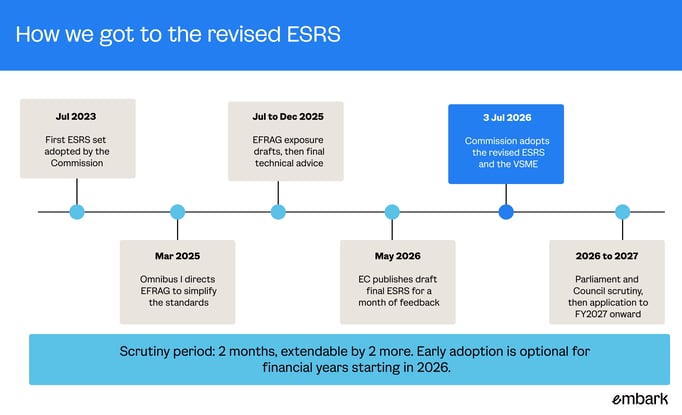
The revised standards are not yet final law. They now move to the European Parliament and the Council of the EU for a scrutiny period of two months, extendable by another two if either institution raises concerns. Assuming no objections, they will be published in the Official Journal and enter into force roughly four months after adoption. The Commission intends the revised ESRS to apply to financial years beginning on or after January 1, 2027, with early adoption permitted for financial years beginning in 2026.
What actually changed
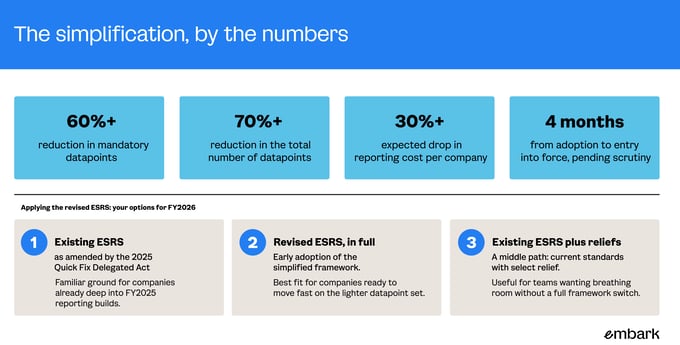
The headline numbers are striking: the Commission expects the revisions to cut mandatory datapoints by more than 60% and total datapoints by more than 70%, with reporting costs falling by more than 30% per company. But the numbers only tell part of the story. The more consequential shift is in how companies are meant to think about materiality and disclosure in the first place.
A top-down materiality assessment
The revised ESRS lean into a top-down approach to materiality. Instead of working through an exhaustive list of individual impacts, risks, and opportunities, a company starts from its business model and strategy and identifies where material issues are likely to arise, given its sector, geography, and activities. Only where materiality is genuinely unclear does the company need to perform a more granular assessment. The standards are also more direct about the boundary: companies are not expected to meet the specific information needs of every individual user, and they now "shall not" disclose immaterial information except in narrowly defined circumstances.
Fair presentation, reframed
The Commission clarified that the fair presentation objective applies to the sustainability statement as a whole, not to each individual datapoint. That is a meaningful shift in emphasis. It gives companies more room to use entity-specific disclosures and more discretion over whether, and how, to break out information by geography or business segment. If a material issue is only relevant to certain subsidiaries or activities, the disclosure can be scoped accordingly rather than forced across the whole group.
There is also a deliberate nod to IFRS here. ESRS now frames entity-specific disclosures as serving the same purpose as the "additional information" concept in IFRS S1, which is a small wording change with a real effect: it reinforces that standard disclosures are a floor, not a ceiling, and that preparers already fluent in IFRS S1 will recognize the underlying logic. On presentation, companies also gained more freedom to structure the statement itself. An executive summary can now sit at the front of the sustainability statement or be placed elsewhere and cross-referenced, and dense material, like EU Taxonomy disclosures or detailed GHG calculations, can move into an appendix instead of running through the main narrative. For a report that has been criticized for burying the useful parts under boilerplate, that is a welcome bit of housekeeping.
New room to omit sensitive information
The revised standards import relief from the Omnibus I Directive that allows companies to omit information that would seriously harm their commercial position, provided four conditions are met: the omission does not prevent a fair understanding of the company's development, performance, or material risks; disclosure at an aggregated level is genuinely not possible without causing that harm; the company discloses that it used the exemption for each affected datapoint; and it reassesses the exemption at every reporting date.
Separately, companies now have flexibility to limit the reporting scope of a metric where reliable data would come at undue cost or effort, and clarification that anticipated financial effects can rely on estimates that are later updated without that update being treated as an error. Transition relief for anticipated financial effects has also been extended: companies already reporting under the existing ESRS can defer qualitative disclosure to FY2028 and quantitative disclosure to FY2030, while companies reporting for the first time under the revised standards for FY2027 or later can omit this information entirely for their first two years and quantitative detail for their first four.
The materiality assessment gets lighter to maintain, not just easier to start
One relief that is easy to miss in the headline numbers: companies no longer need to refresh their double materiality assessment every year as a matter of course. An update is only required when circumstances actually change, or when management judgment indicates one is warranted. For a team that has been treating the annual DMA as a full re-run each reporting cycle, that alone could meaningfully lighten the yearly workload, independent of anything else in the revision.
The standards also sharpened how reporting boundaries work in a few specific, practical situations. Greenhouse gas emissions tied to a leased asset are now attributed to the lessee's own operations, with the lessor accounting for that asset as part of its downstream value chain instead. A similar principle applies to assets held inside an employee pension scheme. And companies that manage assets on behalf of clients, think asset managers, fund sponsors, and similar structures common in private equity portfolios, are not expected to report on the impacts, risks, and opportunities of the assets they manage for others. That is a meaningful clarification for any group with an asset management arm or a portfolio of controlled and non-controlled investments, since the original standards left real ambiguity about where the reporting entity's own footprint ended and a managed asset's began.
Climate disclosures get more flexible, not lighter on substance
On greenhouse gas reporting, companies gain flexibility in setting their organizational boundary, meaning which operations, facilities, and subsidiaries get consolidated into the inventory in the first place. Sustainability reporting will continue to follow the financial control approach by default, matching the perimeter of the consolidated financial statements, but companies can also elect the equity share approach or the operational control approach, both defined under the GHG Protocol Corporate Standard. That is a deliberate move toward how companies already set boundaries for GHG Protocol and IFRS S2 reporting, which should ease reconciliation for groups running both. On transition plans, companies with targets that are not aligned to a 1.5 degree Celsius pathway must be transparent about that fact, though the standards no longer mandate scenario analysis or a five-year target refresh after 2030.
The environmental standards get narrower, not just shorter
Beyond climate, the pollution, water, biodiversity, and resource use standards were each trimmed for focus rather than simply shortened. Microplastics disclosure is now limited to primary microplastics. Water disclosures concentrate on water resources, with marine matters folded into the biodiversity and resource use standards instead of standing on their own. Resource inflow reporting is scoped to key materials rather than every material used in production. The intent across all of these is the same: fewer datapoints, aimed at what is genuinely decision-useful.
Not everything got lighter
It is worth resisting the temptation to read this revision as a one-directional retreat from rigor. A handful of changes actually add specificity. Business conduct disclosures now require companies to report confirmed incidents of corruption or bribery, where the prior standard was less explicit, and to distinguish more clearly between political influence activities and lobbying spend. Human rights incident reporting was narrowed to cover only substantiated instances, which is a relief in one sense, fewer ambiguous entries, but it also means the disclosures that do appear carry more evidentiary weight. The overall shift is toward fewer datapoints that are each more decision-useful, not simply toward less disclosure across the board.
A voluntary standard, and a cap on what can trickle down
Alongside the revised ESRS, the Commission adopted a Voluntary Reporting Standard, built on EFRAG's earlier VSME framework, for companies that fall outside CSRD's scope. This is not a compliance obligation. It is a common reference point so that smaller companies fielding sustainability questionnaires from large customers, lenders, or investors have one standardized way to respond instead of a different bespoke form for each counterparty.
The more important piece for larger groups is the value chain cap. Companies subject to the CSRD cannot require value chain partners with 1,000 employees or fewer to provide sustainability information beyond what the voluntary standard covers. If your EU subsidiary has been fielding expansive ESG questionnaires from its own customers, or sending them to smaller suppliers, that trickle-down dynamic now has a ceiling.
Why this matters if you are a US multinational
Most of the commentary on this revision has understandably focused on EU-domiciled filers. But the practical questions for a US-headquartered group with European operations are a bit different, and worth naming directly.
|
Revisit your scoping analysis Omnibus I already narrowed the population of companies caught by CSRD, and the revised standards carry their own scope marker: a threshold of 1,000 employees and net turnover of 450 million euros for the large-company reporting wave. Some EU subsidiaries that were building toward a heavy FY2025 or FY2026 report may find the lift considerably lighter, may land in a later wave, or may have dropped out of scope altogether. This is worth confirming with your EU subsidiary controllers rather than assuming last year's scoping still holds. |
For financial years beginning in 2026, in-scope companies get an actual choice: keep applying the existing ESRS as amended by the 2025 Quick Fix Delegated Act, adopt the revised ESRS in full, or apply the existing ESRS with select reliefs from the revision. That choice has real consequences for a US parent trying to consolidate reporting timelines and system builds across multiple EU entities, since different subsidiaries in the same group could reasonably land in different places depending on how far along their reporting build already is.
Watch for the ESRS for Third-Country Groups. The revised ESRS adopted on July 3 do not cover the separate standards for non-EU parent undertakings, recently renamed the ESRS-TC by EFRAG. Those standards will apply to large non-EU groups with significant EU turnover and at least one large EU subsidiary or branch, a description that fits a meaningful number of US multinationals. EFRAG's Sustainability Reporting Board approved a draft on July 1, 2026, with public consultation expected to follow later this year and Commission adoption targeted for 2027. This is the track that will most directly determine reporting obligations at the US parent level, and it is still being written.
Interoperability with IFRS S1 and S2 improved, but did not fully converge. The revised ESRS align more closely with ISSB standards on concepts like fair presentation and the use of reasonable and supportable information, and permit qualitative disclosure of financial effects in more circumstances, similar to IFRS practice. Scenario analysis, required under IFRS S2, remains optional under ESRS. For US groups that already report under both frameworks, or that report under IFRS S2 domestically and ESRS through European subsidiaries, some reconciliation work will still be necessary. Full convergence was not part of this revision, despite pressure for closer alignment from various corporates and the ISSB itself.
The value chain cap works both ways. If your group has US suppliers or portfolio companies feeding information into an EU parent's or customer's CSRD report, the same value chain cap that protects EU-based small businesses protects those US counterparties too, provided they sit at or below the relevant size threshold. That is a useful data point to have on hand the next time a European customer's sustainability questionnaire seems to be asking for more than the standards require.
Applying the revised ESRS: The timing decision
The table below lays out the mechanics of when the revised standards take effect and what happens between now and then.
| Milestone | Timing |
| Public feedback on draft final ESRS | Closed June 3, 2026 |
| Commission adoption of revised ESRS and VSME | July 3, 2026 |
| Parliament and Council scrutiny | 2 months, extendable by 2 more |
| Entry into force | Approximately 4 months and 1 week after adoption |
| Mandatory application | Financial years beginning on or after January 1, 2027 |
| Early adoption window | Financial years beginning in 2026, at the company's election |
A few things worth doing now
- Ask your EU subsidiary teams whether their FY2026 reporting build is still assuming the original ESRS datapoint count, and whether an earlier move to the revised standards would actually reduce near-term effort.
- Confirm whether Omnibus I's revised thresholds changed which of your EU entities are in scope at all. Some groups have found the population of in-scope subsidiaries has shrunk since last year's assessment.
- Put the ESRS-TC consultation, expected later this year, on your radar. It is the standard that will eventually apply directly at the US parent level.
- If your team reports under both IFRS S2 and ESRS, start mapping where the standards have converged this round and where a reconciliation step is still needed.
-
If EU customers or partners have been requesting more sustainability data than seems proportionate, the value chain cap is a reasonable basis for a conversation about scope.
The broader arc here is a familiar one in sustainability reporting: an ambitious first framework, a period of real friction in implementation, and a deliberate simplification that keeps the underlying objective intact while asking less of the companies applying it. For US multinationals, the work now is less about learning an entirely new framework and more about deciding, entity by entity, how quickly to move into the lighter one, and keeping an eye on the third-country standard that will eventually bring this conversation home.
If you're preparing for the evolving ESRS landscape, Embark’s ESG reporting services help organizations assess their reporting readiness, navigate changing disclosure requirements, and build a scalable foundation for compliance and sustainability reporting. To learn more, contact us.