When the dust doesn't settle: What finance leaders need to do right now
April was for diagnosing. May is for moving.
The organizations pulling ahead right now aren't waiting for conditions to stabilize. They're building while others deliberate. New standards like DISE are closer than they appear, and the infrastructure work to get there takes longer than anyone budgets for. Healthcare M&A is accelerating, and the organizations that capture value from their deals are the ones that treat integration as a strategy from day one.
Capital markets are moving too. SPACs are back with real discipline behind them, PE-backed companies are running dual-track exits, and the window questions that come with both are back on the table. This issue also gives your team something concrete on AI: field-tested prompt frameworks designed for finance workflows, not just another opinion on what's coming.
May is built for a market that isn't pausing. Here's what to do with it.
.png?width=192&height=42&name=Adam%20Olsen%20Signature%20(1).png)
Adam Olsen
National Head of Practices, Embark
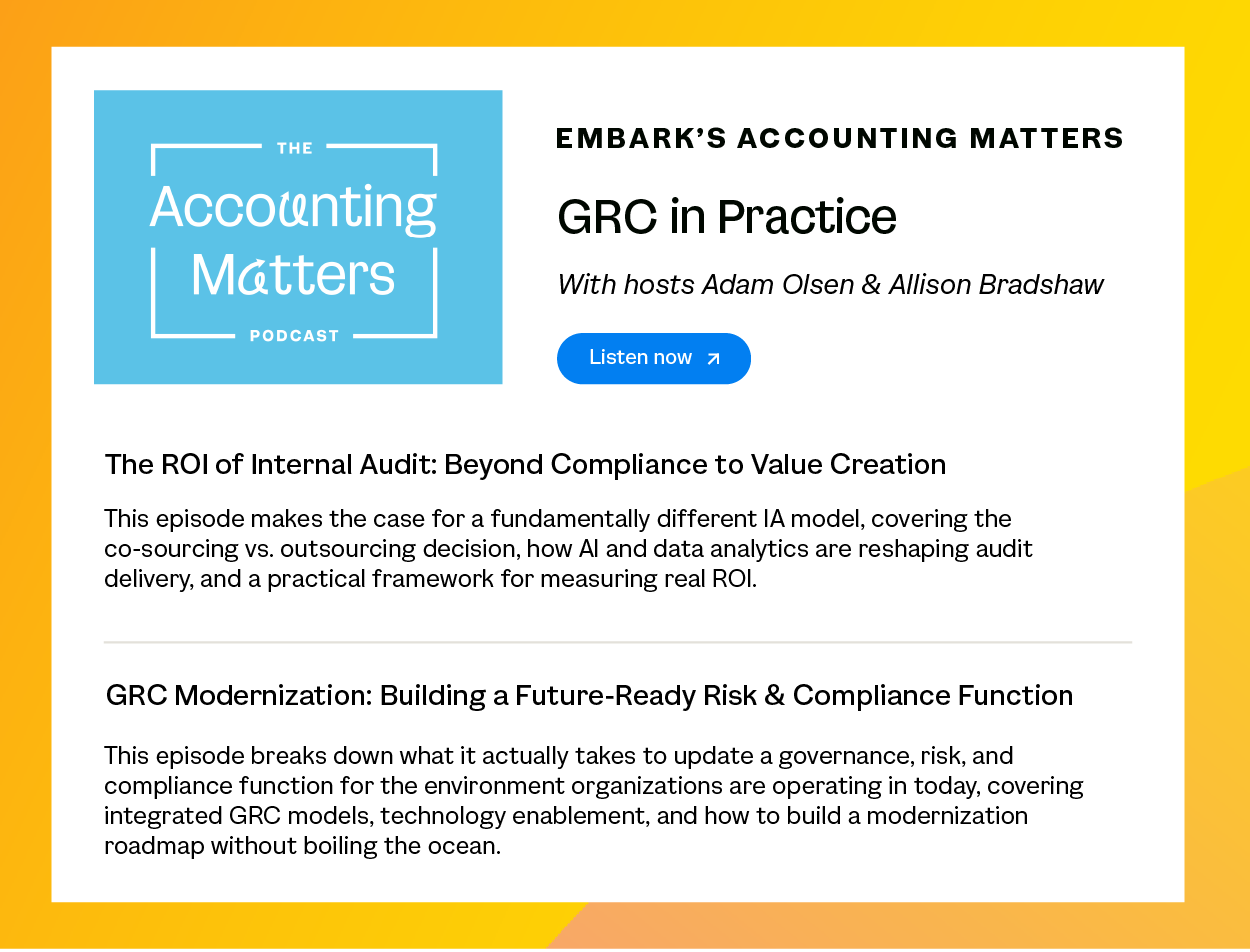
| IN THIS EDITION Resource: Field-tested AI prompt frameworks built for finance and accounting workflows Case study: What it looks like when risk management actually keeps pace with growth Guide: A practical integration playbook for finance leaders navigating healthcare M&A DISE: The DISE deadline feels distant. Your data infrastructure doesn't agree. On our radar: SPAC resurgence, dual-track exits, the SEC’s semiannual reporting proposal, and FASB’s new PIK dividend standard Accounting Matters Podcast: Latest episodes from Embark on GRC in Practice Upcoming events: Embark Ignite & Workiva Accelerate |
FEATURED RESOURCE
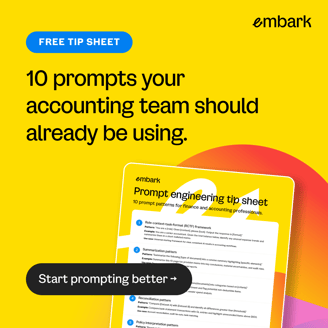
10 AI prompt patterns every finance professional should have
Get field-tested frameworks for finance and accounting teams who want consistent, accurate AI results without having to become a prompt engineer to get them. From data extraction to scenario modeling, these patterns cover the workflows that matter most and are designed to slot into how your team already works.

CASE STUDY
The risk framework that kept pace with growth
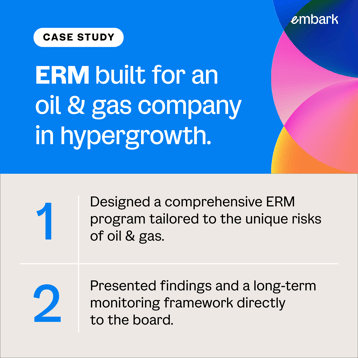
For a publicly listed oil and gas operator in the middle of a hypergrowth cycle, risk management couldn't be an afterthought. Expanding operations and headcount meant expanding exposure across financial, operational, and strategic risk all at once.
The board needed a comprehensive ERM program tailored to the nuances of the energy industry, one that addressed everything from ESG exposure to acquisition risk and could give leadership the visibility it needed to keep growing with confidence. Embark built it from the ground up. See how it came together.

PMI PLAYBOOK
Healthcare M&A is moving fast. Is your integration plan keeping up?
Consolidation in healthcare isn't slowing down, and the organizations that capture value from their deals are the ones that treat post-merger integration as a strategy, not an afterthought.
This guide covers everything from pre-merger planning and governance to financial integration, IT systems, and culture, with practical frameworks your team can put to work immediately.

SERVICE SPOTLIGHT
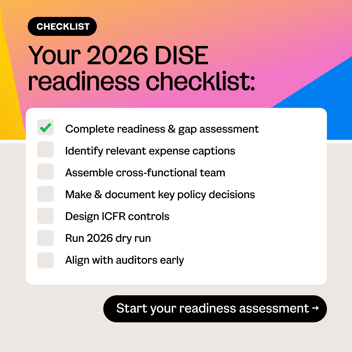
DISE is coming. Most companies aren't ready.
A company can report billions in operating expenses and investors still can't see what's driving them. FASB's new DISE standard changes that, requiring a detailed breakdown of compensation, depreciation, inventory purchases, and more across every major expense line. The deadline feels distant until you realize the systems, processes, and controls work is significant. If your ERP wasn't built to tag expenses by natural category, you're already behind.

ON OUR RADAR SPACs are back. Here's what's different this time: SPACs accounted for nearly 40% of U.S. IPO deal count in 2025, and in just the first two months of 2026, 50 SPACs raised roughly $10 billion compared to 24 traditional IPOs that raised $7 billion in the same window. PE is driving the resurgence. Sponsors need exits, and mature portfolio companies with real operating histories are a very different profile from the projection-driven stories of 2021. The mechanics were never broken. The discipline is back.

IPO or Sale? More PE-Backed Companies Are Refusing to Choose: With both the IPO window and M&A markets reopening after years of uncertainty, PE-backed companies past their expected hold periods are increasingly running dual-track exit processes, pursuing a sale and IPO preparation at the same time. The strategy works because each track strengthens the other, but executing both simultaneously demands financial infrastructure and management bandwidth that most companies underestimate.

SEC Floats Optional Semiannual Reporting: The SEC proposed amendments that would let public companies elect semiannual reporting on a new Form 10-S in place of quarterly 10-Q filings—cutting interim reports from three per year to one. The comment period opens 60 days after Federal Register publication.
The flexibility is real, but the decision isn't simple. Companies will need to weigh investor expectations, debt covenant requirements, and how reduced disclosure frequency lands with lenders, sponsors, or prospective acquirers. For companies in or near a transaction, quarterly cadence may still be the smarter play.

FASB Closes the Book on PIK Dividends with its First ASU of 2026: The FASB issued ASU 2026-01 in April, standardizing how companies initially measure paid-in-kind (PIK) dividends on equity-classified preferred stock. Previously, no authoritative guidance existed, leading to inconsistent practice across companies. The fix is straightforward: PIK dividends must now be measured using the stated rate in the preferred stock agreement—typically a percentage of the liquidation preference. Effective for annual periods beginning after December 15, 2026, with early adoption permitted. Companies with PIK preferred stock outstanding should assess whether their current measurement approach aligns and consider the downstream effects on equity balances and EPS ahead of adoption.






ABOUT EMBARK
High-caliber consulting. High touch service.
Embark is a strategic finance and operations consulting firm built for companies navigating growth and complexity. We partner with organizations that need experienced operators to build scalable systems, strengthen controls, and solve the operational challenges that keep business leaders up at night.