
On May 19, 2026, the FASB issued ASU 2026-02, Environmental Credits and Environmental Credit Obligations (Topic 818). It's the first piece of authoritative U.S. GAAP that directly addresses how to recognize, measure, present, and disclose environmental credits and the regulatory obligations they're used to settle.
For finance teams at companies subject to cap-and-trade programs, renewable fuel standards, renewable portfolio standards, or any other emissions-related compliance regime, the standard introduces a new accounting model that's tied closely to how the entity intends to use its credits. For companies pursuing voluntary net-zero or carbon-neutral commitments, the news is simpler and arguably more disruptive: most of what those programs cost will now hit the income statement when incurred.
Below, we walk through what the new Topic 818 actually requires, where the harder judgment calls sit, and how finance teams can think about organizing for adoption.
Why FASB issued the standard
Environmental credits aren't new. Domestic and global cap-and-trade allowances, renewable identification numbers (RINs) under the U.S. Renewable Fuel Standard, renewable energy certificates (RECs) under state renewable portfolio standards, and carbon offsets used for voluntary commitments have been in financial statements for years. What's been missing is any specific authoritative guidance on how to account for them. In the absence of a direct standard, companies analogized to whichever existing literature seemed closest (Topic 330 on inventory, Subtopic 350-30 on intangibles, or Topic 450 on contingencies), producing meaningful diversity in practice.
Topic 818 was created to fix that. The Board's stated objective is to improve comparability and provide investors with more decision-useful information by replacing analogy-driven judgments with a single, dedicated model.
What's in scope, and what isn't
Topic 818 defines an environmental credit through a four-part test: it must be an enforceable right, it must be separately transferable (or previously have been, with current usability to settle an ECO), it must lack physical substance and not be a financial asset, and it must be represented as preventing, controlling, reducing, or removing emissions or other pollution. Income tax credits usable to settle a tax liability are carved out explicitly.
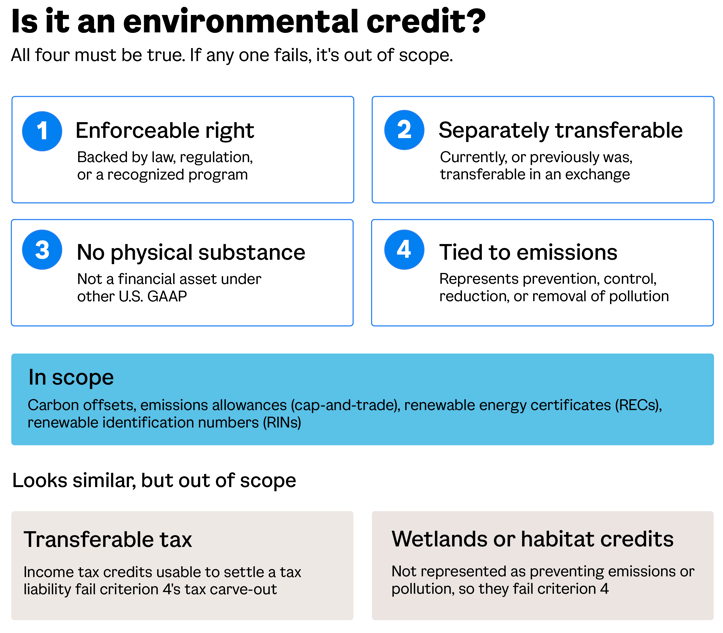
Topic 818 scope test. All four criteria must be met; common boundary cases that fail the test are flagged.
Credits can take many forms (credits, certificates, allowances, offsets), come from many sources (acquired, granted, internally generated, received in a nonreciprocal transfer), and include those from related parties. The four-part test is the gate, not the source.
The two boundary cases highlighted in the visual deserve a little more explanation because they're where companies are most likely to misclassify in good faith. Transferable clean energy tax credits look almost identical to environmental credits from a balance-sheet perspective, but they're carved out because they're income tax credits used to settle income tax liabilities. That treatment is the same even if the holder doesn't currently have a tax liability or doesn't intend to use them that way. Wetlands, habitat, and stream restoration credits get tripped up on the fourth criterion: they're real environmental programs, but they aren't represented as preventing, controlling, reducing, or removing emissions or other pollution. They're outside the standard regardless of how a company accounts for them internally.
Environmental credit obligations
An environmental credit obligation (ECO) is an enforceable obligation arising from existing or enacted laws, statutes, or ordinances represented to prevent, control, reduce, or remove emissions or other pollution that may be settled with environmental credits. Asset retirement obligations under ASC 410-30 are excluded.
One point worth flagging: a company's voluntary climate commitment is not an ECO. The Board pointed to Concepts Statement 8, which holds that an obligation an entity owes only to itself isn't a liability. Public pledges to achieve net-zero by 2040, internal carbon-neutral targets, sustainability commitments in proxy statements, none of these create a Topic 818 liability on their own. An ECO requires an external, enforceable obligation, typically from a regulatory compliance program.
The accounting model in plain terms: intent drives everything
The accounting follows the entity's expected use of the credit. The intent test determines whether the credit is an asset or an expense, and then how the asset is measured. Source (purchased, internally generated, or granted by a regulator) affects initial measurement separately, layered on top of intent.
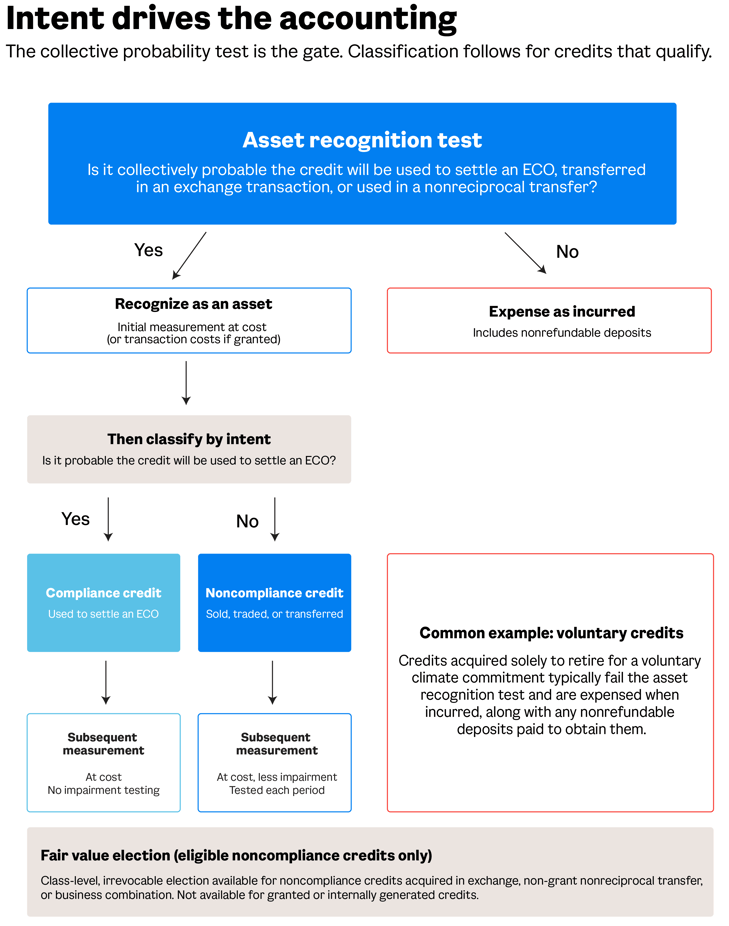
"Probable" carries its U.S. GAAP meaning (the future event is likely to occur), and the assessment is collective: the entity adds the probabilities across the three recognizable uses and tests whether the sum clears the threshold. A credit that is 50% likely to be used for compliance and 50% likely to be sold qualifies for asset recognition because the combined probability is 100%.
Compliance credits aren't impaired because their cost basis flows directly into the linked measurement of the related ECO (covered in the next section), and impairing the asset would create a circular interaction with the liability. Noncompliance credits don't have that linkage, which is why impairment applies and no reversals are permitted. The fair value election shown on the visual is more nuanced than the diagram alone can carry: it's at the class level (not credit by credit), irrevocable, and survives if a credit is later reclassified as compliance. Internally generated and regulator-granted credits are excluded.
On initial measurement, internally generated credits and regulator grants are measured at the transaction costs incurred to obtain them, often just registration or certification fees and frequently zero. A power producer that generates its own RECs, or an oil and gas operator granted emissions allowances by a state regulator, will often carry those credits at near-zero cost basis, which then flows directly into the measurement of any related ECO. Credits acquired under another Topic (most commonly in a business combination) follow that other Topic's measurement rules.
The voluntary-credit treatment is one of the most consequential changes in the standard. The Board's view, in the basis for conclusions, is that a credit acquired purely to be retired voluntarily is economically akin to an asset the company has chosen to abandon. Companies currently carrying voluntary carbon offsets on the balance sheet as intangibles or inventory will derecognize those balances at transition and run the cost through earnings going forward.
Reassessment and reclassification
Intent isn't a one-time determination. At each reporting date, an entity reassesses whether credits still qualify for recognition and whether their classification (compliance versus noncompliance) is still appropriate. A change in intent can drive a reclassification, and impairment testing is required at the point of reclassification before applying the new subsequent-measurement rules.
Similar credits recognized as assets are subsequently measured using average cost, FIFO, or specific identification, selected separately for compliance credits and noncompliance credits.
One asymmetric rule worth noting: credits that were previously expensed (because they failed the asset recognition test) can't be brought back onto the balance sheet later if intent changes. The cost basis is gone. Similarly, those previously expensed credits can't be used to measure an ECO under the linked-measurement approach below. This prevents companies from re-establishing a cost basis to generate a gain when intent shifts. The FASB acknowledged that this means when an entity uses previously expensed credits to satisfy an ECO liability, the entity may recognize a gain when the liability is derecognized.
The linked measurement model for ECOs
Topic 818's ECO measurement is linked to the cost basis of the credits the entity intends to use to settle the obligation, not their fair value. An ECO is recognized as the underlying activity occurs (one credit per megawatt-hour consumed, for example), or once a baseline threshold is exceeded for programs with that structure. At each reporting date, the entity measures the ECO as if that date were the end of the compliance period.
The liability is measured in two parts. The funded portion uses the cost basis of compliance credits on hand, applying the same costing convention (average cost, FIFO, or specific identification) used for the asset. Previously expensed credits can't be used here even if they're now intended for compliance.
The unfunded portion has three sub-layers, applied in order:
-
Cash settlement. Where cash is acceptable under the program and the entity intends to use it, that portion is measured at the cash remittance amount.
-
Firm commitment or regulator entitlement. Where the entity has an unconditional purchase commitment at a fixed price or an unconditional right to receive credits from a regulator, that portion is measured at the cost basis of the incoming credits (which may be zero for a regulator grant, or differ from the contract price for a firm commitment).
-
Remaining balance. Anything left is measured at fair value under ASC 820.
A single ECO can mix all three sub-layers. The practical implication: a company granted enough no-cost credits to fully satisfy its obligation reports an asset and a liability of zero, while a company holding purchased credits at a nonzero cost basis reflects that basis on both sides of the balance sheet.
Linked measurement is not net presentation
It's worth being precise here, because the two ideas get conflated. Linked measurement is a measurement concept: the carrying amount of the liability is tied to the cost basis of the assets that will settle it. Presentation is separate and is always gross. The ECO and the related credit asset appear on the balance sheet on a gross basis, with the right-of-offset requirements in ASC 210-20-45-1 explicitly not satisfied.
This matters for classified balance sheet presentation, debt covenant calculations, and any analyst metric that relies on gross asset or liability balances.
Acquisitions: a Topic 805 carve-out
Under ASC 805 as amended by Topic 818, environmental credits acquired in a business combination are recognized as assets at acquisition-date fair value regardless of intended use, including credits the acquirer plans to retire voluntarily. At the next reporting date, the acquirer applies Topic 818's reassessment rules, and credits still expected to be retired voluntarily are derecognized through earnings. In other words, the same voluntary credit is briefly an asset when acquired in a business combination but expensed at acquisition outside of one. The Topic 805 amendments apply prospectively to transactions after the date of initial application.
For ECO recognition in a business combination, the acquirer assumes the acquisition date is the end of the compliance period when identifying liabilities to recognize.
Disclosures, including the DISE crossover
Topic 818 brings a substantial set of new disclosures. They fall into three natural groups:
About the credit portfolio
-
How credits were obtained, their intended use, and the current and noncurrent amounts of compliance and noncompliance credits with reference to balance sheet line items
-
Subsequent measurement method (FIFO, average cost, or specific identification), plus ASC 820 fair value disclosures for credits measured at fair value
About the ECO liabilities
-
The activities or events giving rise to ECO liabilities, the nature and timing of settlement provisions, and the accounting policies applied
-
How the unfunded portion of the ECO is measured
About income statement impact
-
Total expense for credits not initially recognized or subsequently derecognized, total impairment expense (with the nature of and circumstances leading to the impairment), and the effect of any change in intended use
-
Total expense recognized for ECO liabilities, total costs capitalized into another asset (with a description of that asset), and the related income statement line items
-
Significant estimates and judgments used throughout
For public companies subject to the disaggregation of income statement expenses standard (ASU 2024-03), Topic 818 includes a consequential amendment to ASC 220-40 that pulls the new line items into the tabular disclosure. Specifically, the tabular disaggregation must include total expense for credits not initially recognized as assets or subsequently derecognized, total impairment expense on credits, and total expense for ECO liabilities.
For companies that have been working through DISE implementation, this is one more category to map. For companies that haven't yet started DISE work, it's a reason to coordinate the two adoption efforts.
Effective dates and transition
Topic 818 takes effect in fiscal 2028 for public companies and one year later for other entities, with the transition applied through a cumulative-effect adjustment.
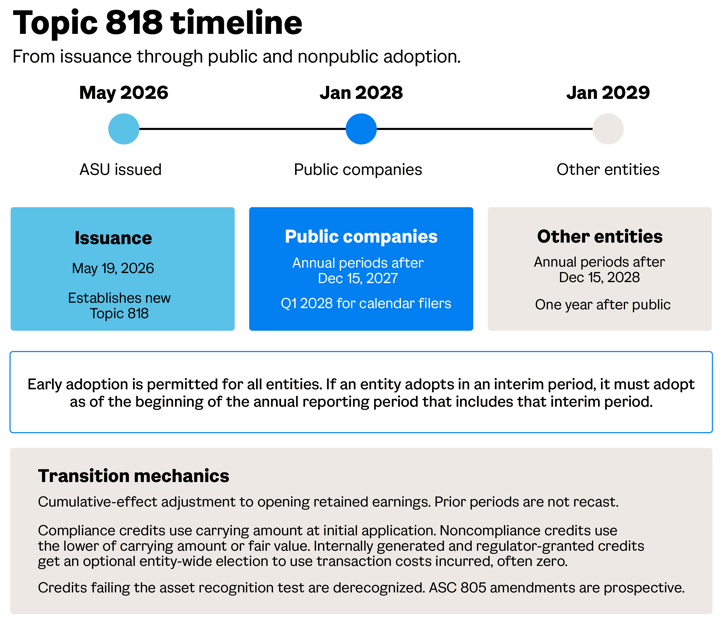
Two transition wrinkles are worth flagging beyond the visual. Entities that elect to measure an eligible class of noncompliance credits at fair value measure those credits at fair value as of the date of initial application, rather than the lower-of-carrying-amount-or-fair-value rule that applies to other noncompliance credits. And because the ASC 805 amendments apply prospectively, business combinations completed before the date of initial application aren't restated.
The finance and sustainability handshake
Topic 818 is a financial accounting standard, but the data and judgment it requires sit at the intersection of finance and sustainability. That's a place where most companies don't have a clean playbook.
To apply the standard, finance teams need things sustainability teams typically own: emissions and activity data at quarterly granularity, credit inventories that often live in registry accounts or broker statements that finance has never touched, and forward-looking intent documentation that depends on the sustainability roadmap. The probability assessment that drives classification, will these credits be used for compliance, sold, or retired voluntarily, isn't a finance judgment in isolation. It's a joint call.
The companies that adopt smoothly will be the ones that build the finance-sustainability connection deliberately rather than improvising it at quarter-close. That means shared data definitions, agreed-upon intent documentation, joint controls over credit movement and retirement, and a single source of truth for the credit portfolio that both functions can rely on. For companies with active voluntary programs, it also means revisiting whether the current program structure is the right one given that the cost now flows through earnings as incurred rather than sitting on the balance sheet.
This is where Topic 818 readiness becomes broader than a technical accounting exercise. It's an operating-model question.
Organizing for adoption
Topic 818 affects more than just the technical accounting team. A thoughtful adoption process touches credit management, sustainability reporting, internal controls, and disclosure preparation. The work breaks down naturally into a few workstreams that can run in parallel:
Build a complete inventory of credits and obligations. A single source of truth for every credit on the balance sheet, every credit currently expensed, every regulatory compliance program the company participates in, and every voluntary commitment that involves credit retirement. This includes credits held in subsidiary ledgers, broker accounts, and registry accounts that finance may not have visibility into today.
Document intent for each material class of credits. Because the accounting depends on the collective probability of use, the supporting analysis for each class needs to be captured in a way that can be re-performed at each reporting date. Where intent is mixed, the collective probability assessment is worth working through now so the framework is in place at adoption.
Map ECOs to the underlying programs. For each regulatory compliance program, identify the unit of activity that drives the obligation (megawatt-hours consumed, gallons produced, tons emitted) and confirm that systems can produce the data needed to recognize the liability through the year.Coordinate with the DISE workstream. If the company is a public business entity already working through ASU 2024-03 adoption, Topic 818's tabular disclosure requirements can be built into the same workstream rather than handled separately.
Consider the fair value election. For eligible classes of noncompliance credits, the irrevocable fair value election can simplify subsequent accounting, eliminate impairment testing, and align reporting with how trading desks already think about the portfolio. Because the election is irrevocable, it merits real analysis before adoption.
Align with sustainability leadership on voluntary programs. Companies that have been capitalizing voluntary credits will see those balances come off at transition, with future cost flowing through earnings. CFOs, sustainability leaders, and investor relations teams benefit from aligning early on what changes, how it's explained to investors, and whether the current voluntary program structure still makes sense under the new accounting.
Engage the auditor on judgment areas. The standard introduces meaningful judgment around probability assessment, classification, reclassification, and impairment. Aligning with the auditor on the company's approach as the framework develops makes for a smoother adoption.
Topic 818 affects far more companies than just heavy emitters. Anyone that holds, generates, or settles obligations with environmental credits has a role to play in adoption, and the companies that approach it as a cross-functional exercise rather than a pure accounting one tends to land in the best position.
Embark's technical accounting and ESG advisory teams help finance and sustainability leaders work through new standard adoptions like this one together, from intent documentation and credit inventory through controls design and disclosure. Reach out to start the conversation.