Midyear momentum: Big news from Embark and what's shaping the second half of the year
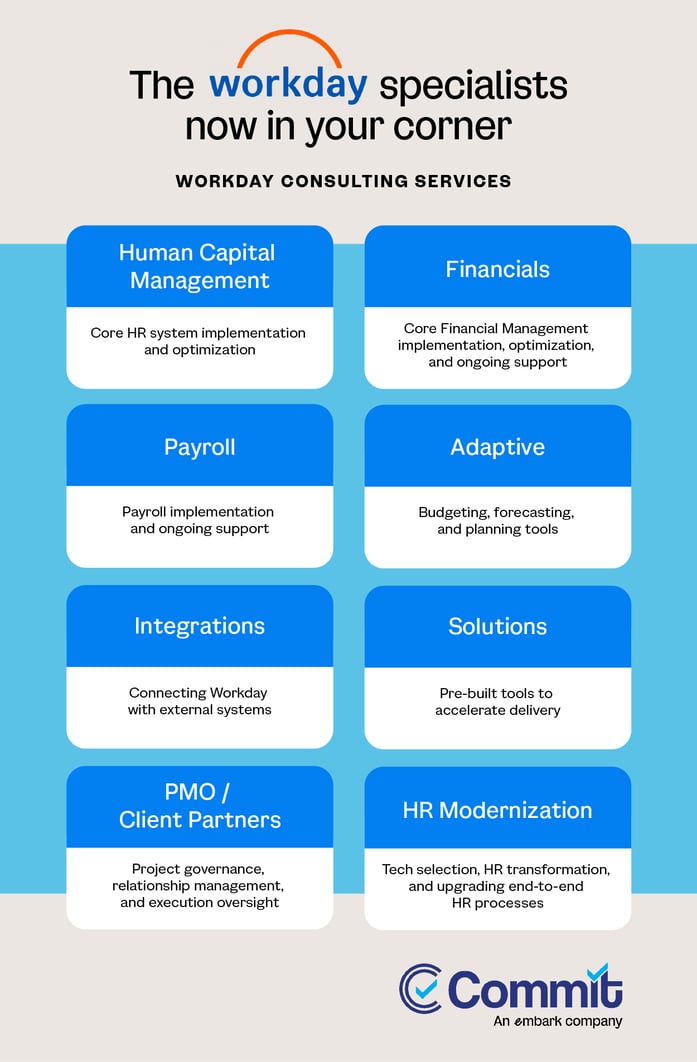
I'm excited to share some big news this month. On June 16, Embark announced the acquisition of Commit, a Workday consulting firm that has spent years earning a reputation for doing the work right.
Commit has built their entire practice around helping organizations get more value out of Workday: stabilizing environments post go-live, optimizing platforms that have drifted, and supporting the change management that makes transformation actually stick. They've done it with a level of care that shows up in their numbers: an 86 NPS, Workday's Partner of the Year for Medium Enterprise, and a client base that keeps coming back. It's the same standard Embark holds itself to, and exactly why this felt right.
Together, we're 800+ people strong across 40+ markets, and we can now support the full arc of what modern organizations are trying to do, from financial strategy to people operations, from transformation planning through ongoing optimization.
Our people, our culture, and our commitment to clients are not changing. What is changing is the depth of what we can bring to the table when the moment calls for it. We hope the first half of 2026 has been a strong one for you. We head into the second half with more to offer, and we look forward to being part of what comes next.

— L. Felice Gorordo,
CEO, Embark
| IN THIS EDITION Spotlight: Commit, an Embark Company: Why Embark and Commit joined forces, what they do, and what the combined firm means for the clients we serve AI on the Books: A finance leader's guide to accounting for AI costs under U.S. GAAP and ASU 2025-06 Fast-Track FloQast with Embark: How to get FloQast live faster and avoid the most common implementation blockers SEC Filer Status Proposal: What the SEC's proposed overhaul of public company reporting requirements means for registrants and IPO candidates Topic 818: FASB's first dedicated accounting standard for environmental credits and what it means for your balance sheet |
Why Embark and Commit are joining forces
The Embark and Commit combination expands what we can do for you, without changing anything about how we work together today.
|
Finance meets people ops. |
|
Full lifecycle support. |
|
Same standard of care. |

AI ACCOUNTING GUIDANCE
Your company is spending on AI. Do you know where it lands on the financial statements?
AI is no longer just a strategic priority. It is a line item, and for many organizations, a significant one. But the accounting guidance has not kept pace with how companies are actually building and deploying AI today. This guide walks finance leaders through the current U.S. GAAP framework, what changes under ASU 2025-06, and how to make the right calls on capitalization, data costs, and disclosure before your auditors start asking questions.

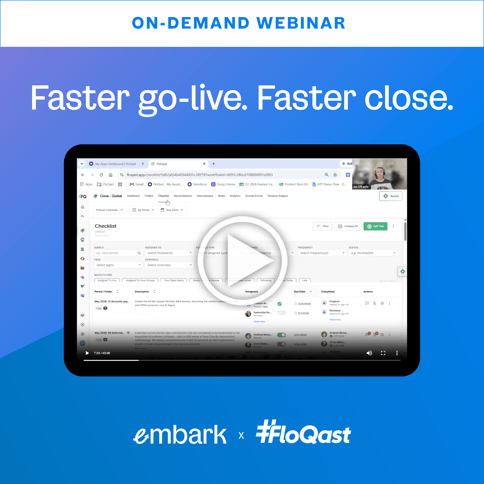
ON-DEMAND WEBINAR AND DEMO
The fast-track FloQast implementation guide
The biggest barriers to a fast FloQast go-live are predictable, and most of them are avoidable. In this webinar, Embark and FloQast walked through how to achieve a quick go-live, what typically slows things down, and a real client example of a fast, low-lift implementation. Whether you are early in your research or already scoping a project, the recording will give you a clearer picture of what implementation actually looks like.

ON OUR RADAR The SEC wants to simplify public company reporting. Here is what actually changes: On May 19, the SEC proposed collapsing its five-category filer framework down to two and raising the large accelerated filer threshold from $700 million to $2 billion in public float. The practical effect: over 80% of public companies would qualify for scaled disclosure accommodations, and every newly public company would automatically receive non-accelerated filer status for five years regardless of float. That means no 404(b) auditor attestation, reduced executive compensation disclosure, and two years of audited financials instead of three. The proposal is still in comment, but public companies, IPO candidates, and SPAC targets should start working through the implications now.

FASB just issued the first dedicated U.S. GAAP standard for environmental credits. Here is what Topic 818 requires: FASB issued ASU 2026-02 in May, establishing Topic 818 as the first authoritative U.S. GAAP guidance written specifically for environmental credits and the regulatory obligations they settle. The core principle is that accounting follows intent: whether a credit is held for compliance, available for sale, or earmarked for voluntary retirement determines how it is recognized, measured, and presented.
The most significant practical change is for companies carrying voluntary carbon offsets on the balance sheet, which will need to derecognize those balances at transition, with future costs flowing through the income statement as incurred. Topic 818 is effective for public companies in fiscal 2028, but finance and sustainability teams should start coordinating on adoption now.